Natalie Donovan
The Vampire Prince’s BrideNatalie Donovan’s decisive importance lies in the collision between an ordinary human crisis and an interstellar system that treats women, pregnancy, and political succession as matters of acquisition. She enters the story devastated by rejection and convinced that her body makes her unworthy of love; she then becomes the unwilling human center of Erdal’s dynastic claim. Her arc moves through humiliation, abduction, pregnancy, emotional attachment, and royal elevation, making her both a vulnerable subject of alien power and the person through whom that power acquires a human future.
Identity and Introduction
Natalie is introduced on Earth in a state of acute emotional collapse. In the mirror, she sees not a complex person but what she calls a ghost of a woman: her long dark hair is matted, her eyes are bloodshot, her makeup has run, and alcohol, nausea, and tears have reduced the scene to a physical record of despair. At twenty-six, she measures herself against an imagined standard of beauty and success, describing herself as overweight, ugly, and unsuccessful. The immediate cause is Matt’s rejection. After ignoring her calls and texts, he tells her that he will not see her again because he is engaged to Tyra, turning Natalie’s hopes for his birthday into another source of humiliation.
That self-condemnation is important because the narrative initially allows Matt’s choice to become, in Natalie’s mind, a verdict on her entire identity. Her body is treated by her own thoughts as evidence of failure rather than as a living reality with desires and capacities of its own. The emotional violence of this scene prepares the reversal that follows: Natalie does not become valuable because she changes her appearance, but because another world recognizes a use, a destiny, and eventually a personal bond in the very body she has learned to despise.
Abduction and the Alien Threshold
Natalie leaves the bar with Erdal partly because she wants to escape the pain of Matt’s rejection. She is drawn to the handsome stranger and accepts the possibility of spending the night with him despite knowing that she may regret it. Erdal, however, is concealing far more than his hood suggests. He drives her away in his Ford Mustang, and she notices that he refuses to remove the hood, correctly sensing that he is hiding something. The scene therefore presents her apparent attempt at temporary consolation as the threshold into an entirely different life.
She soon discovers that the encounter was not an ordinary romantic escape. Erdal has abducted her and taken her aboard Star Ship Xoraii, which is traveling to planet Estion. When he brings her food in a dark gray suit and tells her where she is, panic replaces the fragile comfort she had sought. She realizes that she is far from Earth, trapped on an alien vessel, and confronted by a man whose face reveals that he is not human. Her fear is intensified by Erdal’s own unsettled response to her. He has abducted other women before, but Natalie affects him differently: her presence makes him feel weak, and that weakness troubles him.
Natalie’s crossing into alien space is also a crossing into technological estrangement. Elsewhere in the book, advanced bodies and machines blur the boundary between human and constructed life: Sara can remove one of her bionic eyes and use it to conceal a stun grenade; Lisa undergoes a detailed medical scan that builds a three-dimensional holographic image of her uterus and embryo; and Shay explains that Stlozyn ancestors were humans whose genes were made more pronounced and supplemented with additional DNA. These parallel developments place Natalie’s pregnancy within a larger posthuman world in which species, bodies, reproduction, and technology are unstable categories rather than fixed oppositions.
Pregnancy and Reproductive Power
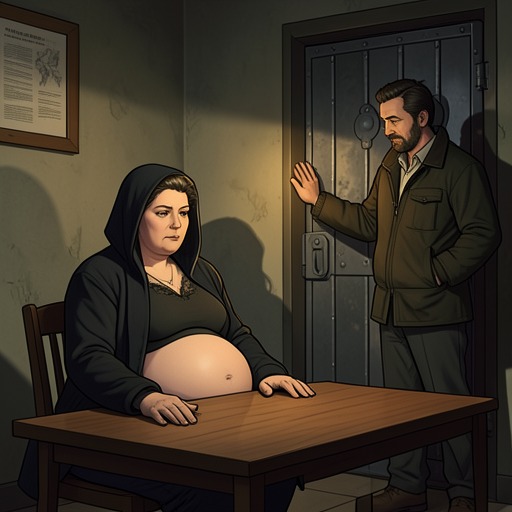
Erdal tells Natalie that she is pregnant and that the baby is his. The revelation compounds the shock of abduction with a new physical and political reality. Natalie reacts with panic, sobbing and asking what will happen if the king learns of the pregnancy. Her fear is not merely the fear of an unexpected child; it is the fear of being carried into a hierarchy where her body has already become evidence in a royal conflict.
The wider narrative repeatedly exposes the exchange value attached to reproduction. Maskin gives Cheryl a grass necklace, an intimate gesture that contrasts with the warrior-slave system in which women are scarce and orbots are distributed to men as temporary rewards. A different logic appears when Sheridan tells Maribel that he wants her to bear his child, reducing her arrival at the vampire palace to the beginning of a reproductive claim. Killian, by contrast, attempts to secure Danita’s freedom through payment, agreeing to buy her from the Lion and promising to pay her debt plus an additional two hundred and fifty thousand. These situations differ in emotional texture, but together they show a world in which bodies, children, debt, and political continuity are repeatedly made objects of negotiation.
Natalie’s pregnancy therefore does not simply add romance to her story. It makes her a biological and dynastic intermediary between Earth and Estion. Her human origin matters because human DNA has unusual significance across the book’s interspecies plots, while the child matters because Erdal’s claim to power is ultimately expressed through succession and family. Natalie’s body is the meeting place of those pressures, and her own wishes must be recovered within circumstances that begin with no meaningful consent.
Erdal, Marriage, and the Throne
Despite the coercive beginning, Natalie’s relationship with Erdal develops through a mixture of attraction, vulnerability, and possession. Erdal is affected by her scent and struggles to understand why she makes him feel weak. His response is not presented as detached strategy; it is an involuntary bodily reaction that unsettles his established identity as an abductor and political actor. Natalie, meanwhile, initially seeks only distraction from Matt, but the encounter becomes the source of a relationship that will reorganize her life.
Erdal eventually asks Natalie to become his bride and places the silver Erasmeth amulet around her neck. She agrees after a pause, still dazed by his passion. The amulet functions as more than jewelry: in the surrounding dynastic mythology, objects can disclose or authorize intimate and political bonds. Darilth’s silver band bearing the large blue Draco’s Eye recognizes Ella as his destined mate when the stone glows and fits itself to her wrist. Erdal’s Erasmeth similarly marks Natalie’s passage from abducted outsider toward chosen partner, although the symbolic gesture cannot erase the unequal conditions under which the relationship began.
Their bond is finally joined to political transformation when Erdal returns after overthrowing King Zutaar. He tells Natalie that he now rules the land and assures her that everything will be all right, calling her his beautiful queen. She asks what happened to Zutaar and notices the swelling on Erdal’s face, evidence of what he endured in taking the throne. Dr. Barca’s treatment heals Erdal’s wounds quickly, but Natalie’s significance is not reduced to the king’s survival: her pregnancy and marriage give the new reign a future, while her elevation makes the formerly abducted human woman part of Estion’s ruling order.
Change, Agency, and Narrative Significance
Natalie’s transformation is deliberately contradictory. At the beginning, she sees herself through the language of rejection, fatness, ugliness, and failure. At the end of the documented arc, Erdal sees her as beautiful, asks her to marry him, and presents her as queen. The contrast supplies emotional repair, but it also exposes the limits of a romance that answers female self-loathing primarily through male recognition. Natalie’s value is restored through Erdal’s gaze even as she enters a system that first removes her freedom and then assigns her a reproductive and royal role.
Her story is nevertheless not only a passive ascent. Natalie notices Erdal’s concealment, recognizes the alien nature of her surroundings, responds to the pregnancy with fear rather than automatic acceptance, and asks direct questions about the king and the change in Erdal’s status. Her movement through the plot is marked by attempts to understand the structures that have overtaken her. That questioning matters in a book where women frequently become the ground on which political succession, species survival, and male claims are fought.
Natalie’s ending position is therefore both empowering and unresolved. She is no longer the abandoned woman at the mirror or the isolated human captive aboard Star Ship Xoraii; she is Erdal’s bride, the pregnant mother of his child, and the promised queen of Estion. Yet the route to that position passes through abduction and reproductive appropriation. Her arc gives the narrative a distinctly posthuman and feminist tension: human identity is not pure or self-contained, but Natalie’s incorporation into an alien order raises the question of whether a new identity is freely chosen or merely bestowed by the power that controls the body. In that tension, her character embodies the book’s recurring fusion of intimacy, technology, species difference, and political succession.